
Lesson 1: Lab Fundamentals I
Density
Density is another property of materials with which you need to be familiar. It is different than either mass or volume but it is related to both. (That is why this topic is in its own section, rather than under "Measurement" or "Calculations.") In fact, density is the relationship between mass and volume. Density cannot be measured directly like mass and volume can. Instead it is calculated from measurements of mass and volume.
Consider two samples of iron--say a cast iron skillet and a nail. Both are made of roughly the same material. The skillet is many times larger in volume than the nail. It is also many times heavier in mass. Because there is more iron in the skillet it weighs more and it takes up more volume. Both mass and volume are called extrinsic properties because their values depend on how much material is in sample.
Definition | Lab Work | Study Check: Density
Definition of Density
Density is defined as the ratio of mass to volume, that is the mass of a sample divided by the volume of the sample. If you have a larger sample, it will weigh more. But it will also have a proportionately larger volume. So the ratio of the mass to the volume will remain the same. Density is called an intrinsic property because its value does not depend on how much of the sample you have, but rather what the sample is made of. (Properties that do change based on the amount of the sample are called extrinsic properties; these include mass and volume.)
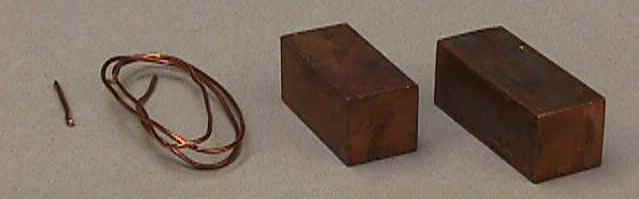
|
0.115g = 8.9g/mL |
1.308g = 8.9g/mL |
37.129g = 8.9g/mL |
44.162g = 8.9g/mL |
So, density is the relationship between the mass of a material and the volume that it occupies. Specifically, it is the amount of mass per unit of volume or the amount of mass divided by the volume. Generally, we use grams per milliliter when dealing with solids and liquids. If we were to measure the density of gases, we would generally use grams per liter because it takes a larger volume to get a measurable mass.
Lab Work
You already know how to measure mass and you know how to measure volume. You will use those talents in the lab to determine the density of several materials. You will find instructions for this in your workbook in Exercise 31. Please note that you are supposed to measure the mass and volume as accurately and precisely as possible. This means use the skill of estimating between the lines. If you are in the lab, take time now to do this experiment, then continue with the lesson. Otherwise, you can do this exercise when you come to the lab.
When you calculate the density in this experiment, you must be sure you report the density with the proper units and with the proper number of significant digits. That is you have to decide where to round off the value you have just calculated. You can refer back to Calculations: Sig. Dig. if you need to review the guidelines for rounding off.
Study Check: Density
Answer the following questions about density. (Answers follow below.)
1. The density of a material can be defined as:
a. the volume of a sample added to its mass.
b. the volume of a sample divided by its mass.
c. the mass of a sample divided by its volume.
d. the mass of a sample multiplied by its volume.
e. the gravitational attraction of the sample to the surface of the earth.
2. What is the density of a material if a 14.0-mL sample weighs 25.0 g?
a. 0.56 g/mL
b. 1.79 g/mL
c. 5.60 g/mL
d. 39.0 g/mL
e. 350 g/mL
Answers
1. The density of a material can be defined as:
c. the mass of a sample divided by its volume.
2. What is the density of a material if a 14.0-mL sample weighs 25.0 g?
b. 1.79 g/mL