
Lesson 7: Bonding Between Atoms
With the review material from the previous pages about classifications of atoms and tendencies to gain and lose electrons in mind, let's consider bonding between atoms. The very heart of bonding is the attraction between positive and negative charges, specifically the positive charge of the nucleus and the negative charge of the electrons. The varying tendencies of atoms to gain or lose electrons allows them to attract one another in various ways and form different kinds of bonds.
Determining Bond Types
Because the inert gases are not particularly good at either gaining or losing electrons, they are not particularly good at forming bonds. They do form some bonds, but not many and with difficulty, and we won't be concerned with them here.
So, if we ignore the inert gases, then we have two types of atoms: metallic atoms and nonmetallic atoms. There are three combinations in which these types of atoms can bond to one another. First, metal atoms can bond to other metal atoms in what we call, naturally, metallic bonding. Second, nonmetal atoms can bond to other nonmetal atoms in what should perhaps be called nonmetallic bonding, but instead we call it covalent bonding. Third, metal atoms can bond to nonmetal atoms in what we call ionic bonding. |
|
||||||||||||

Keep in mind throughout this lesson and in lesson 8 that you can (and should) use this simple idea to determine the type of bonding by looking at the types of atoms that are involved. Like many generalities this is an oversimplification (particularly with transition metals and metalloids), but it can be very useful one.
Ionic and covalent bonding result in compounds. Metallic bonding between two (or more) different metals always results in alloys, or mixtures, without fixed compositions. There are systematic ways of naming ionic and covalent compounds, and we will learn how to name them in this lesson (ionic compounds) and in lesson 8 (covalent compounds). There is not yet a systematic way of naming alloys like those for naming covalent and ionic compounds. In part, this is because alloys are not compounds - their composition is variable and their names need to reflect that. Generally, we use common names like brass, bronze, or steel or technical names like alnico I, alnico II, chromium steel or high carbon steel. We will not be concerned with naming these alloys.
Bond Type Characteristics
Metallic, ionic, and covalent are the three primary types of chemical bonding. We can call them atomic bonds because they bond atoms together. Here are some things to keep in mind as you study each of these types of bonding. Ionic and covalent are the most important in chemistry because ionic and covalent bonding can result in the formation of compounds. You will see that ionic and covalent bonding between different elements results in the formation of compounds because the atoms of different elements bond to one another in fixed ratios. Remember, fixed ratios of one element to another is a crucial characteristic of compounds. Metallic bonding results in the formation of alloys rather than compounds because it does not require that the atoms combine in fixed ratios.
The nature of ionic bonding is addressed in the next three sections of this lesson. Metallic and covalent bonding will be addressed in Lesson 8.
Practice
Try your hand at using this generality by doing exercise 4 in your workbook. You can check your answers below.
Answers
Sodium bonds to sodium using metallic bonding (metal to metal). Sodium bonds to iron with metallic bonding (again, metal to metal). Sodium bonds to fluorine with ionic bonding (metal to nonmetal). Iron bonds to fluorine with ionic bonding (metal to nonmetal). Phosphorus bonds to fluorine with covalent bonding (nonmetal to nonmetal). Fluorine bonds to fluorine with covalent bonding (nonmetal to nonmetal).
If you got all of these correct, continue. If not, check with the instructor, explain your answers and find out why these pairs of atoms are considered to have the kinds of bonds listed.
Ionic Bonding
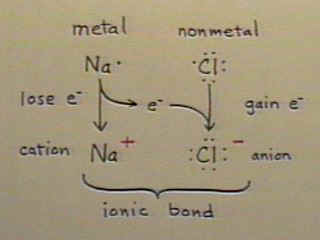
Ionic bonding is perhaps the easiest of the three bond types to comprehend because it ties in with the idea that opposites attract. Specifically, opposite electric charges attract one another. Remember that metallic atoms tend to lose electrons. When they do so, they become positively charged ions which are called cations. Nonmetallic atoms tend to gain electrons to become negatively charged ions which are called anions. These oppositely charged cations and anions are attracted to one another because of their opposite charges. That attraction is called an ionic bond. We often refer to the charge on the ion as the oxidation state of that element. |
|
In the next few pages of this section we will first consider the ions that are formed from the elements and then the ionic compounds formed by those ions.