
Lesson 7: Ions and Their Names
We have discussed earlier how the position of an element on the periodic table determines how likely it is that the atoms of that element will gain or lose electrons.
The position on the periodic table also influences how many electrons are gained or lost, but with a twist. As it turns out, the elements that are most likely to lose electrons do not lose the most electrons. They lose only one electron. Also, the elements with the strongest tendency to gain electrons do not gain the greatest number of electrons. They gain only one electron.
So let's look at how many electrons will be gained or lost by different kinds of atoms. Quite often this can be determined by looking at the position of the element on the periodic table. We will look first at cations, then anions, and then polyatomic ions which are charged clusters of atoms. We'll also look at the names of the ions.
Cations | Anions | Polyatomic Ions
Cations
First let's look at the metals, which are more likely to lose electrons than gain them.
|
All of the elements in Group I-A have one electron in their outermost energy level. All of these elements can lose that one valence electron. These atoms become cations with a positive one charge. To name these simple, predictable ions we simply use the name of the element - lithium ion, sodium ion, potassium ion, and so on. Elements in Group II-A have two electrons in their outermost energy level. So, when these elements lose electrons, they lose two electrons and take on a positive two charge. These simple, predictable ions are called beryllium ion, magnesium ion, calcium ion and so on. |

|
Now for some challenges. The transition metals and the metals to the right of them generally form more than one ion. We call these elements multivalent. (Metals that do not form more than one ion, like the ones in Groups IA and IIA, are called "simple.") The charges on the multivalent elements' ions are not always predictable, although some patterns do exist. Consequently, you won't be expected to predict these, although you will be expected to work with them.
Two of these transition elements are important enough and common enough that you should memorize the charges on their ions. They are iron and copper. Iron forms the 2+ ion and the 3+ ion. Copper forms 2+ ion and 1+ ion. |
|
||||||||||||
A few of the transition elements form only one ion or oxidation state. For example zinc ion, silver ion and scandium ion. For this course, you'll need to remember Zn and Ag and their ion charges, but not Sc. |
|
Now we need to deal with naming the ions for multivalent metals. Since these metals form more than one ion, that means that when we name these metals we need to indicate which ion we are using.
Each different ion needs to have its own distinct name. The modern (and somewhat simpler) way to name these kinds of ions is to put the charge (or oxidation state) in parentheses using Roman numerals after the name of the element. For example chromium(II) ion and chromium(III) ion. This is called the Stock name. |
|
An older method uses an "-ic" ending for the higher charge or oxidation state and an "-ous" ending for the lower charge or oxidation state. For example, chromous ion and chromic ion. (I like to remember it as there's an "i" in "higher" and an "o" in "lower".) |
|
When the ous/ic method of naming is used, the Latin name for the element is often used in place of the modern name. The ions of iron, for example, can be called ferrous ion and ferric ion. |
|
You will memorize the common ion charges for iron and copper. You also need to memorize their names. Iron forms the iron(III) ion and the iron(II) ion. The old names for these are ferric ion and ferrous ion. Copper forms copper(II) ion and copper(I) ion. The old names for these are cupric ion and cuprous ion. |
|
||||||||||||
Zinc ion, silver ion and scandium ion are all "simple" metals. Consequently these ions do not need a Roman numeral attached to them when you name them. |
|
To the right of the transition metals we have Group IIIA. Boron is not a metal so we need not consider it now. Aluminum is a metal and has three valence electrons. It can lose those three valence electrons to form an ion with a positive three charge. It is called aluminum ion. So does gallium, usually. However, because of the influence of the d electrons, sometimes gallium will lose only one electron and form an ion with a positive one charge. In that regard, gallium and the other metals below and to the right of it must be named like transition metals with a Roman numeral or the -ic/-ous endings. |

|
Practice with Naming Cations
The common charges for ions of several of the elements are shown here (and listed in exercise 5 in your workbook). Take time now to name all of these ions using both the modern (Stock) and old names where appropriate. If the old names require using the Latin names for the elements, they are given in the exercise 5. Check your answers below or with the instructor and then continue. |

|
Answers
| Element | Charge | New name | Old name |
| chromium | |||
| +2 | chromium(II) ion | chromous ion | |
| +3 | chromium(III) ion | chromic ion | |
| cobalt | |||
| +2 | cobalt(II) ion | cobaltous ion | |
| +3 | cobalt(III) ion | cobaltic ion | |
| copper | |||
| +1 | copper(I) ion | cuprous ion | |
| +2 | copper(II) ion | cupric ion | |
| iron | |||
| +2 | iron(II) ion | ferrous ion | |
| +3 | iron(III) ion | ferric ion | |
| lead | |||
| +2 | lead(II) ion | plumbous ion | |
| +4 | lead(IV) ion | plumbic ion | |
| mercury | |||
| +1 | mercury(I) ion | mercurous ion | |
| +2 | mercury(II) ion | mercuric ion | |
| nickel | |||
| +2 | nickel(II) ion | nickelous ion | |
| +3 | nickel(III) ion | nickelic ion | |
| silver | +1 | silver ion | silver ion |
| tin | |||
| +2 | tin(II) ion | stannous ion | |
| +4 | tin(IV) ion | stannic ion | |
| zinc | +2 | zinc ion | zinc ion |
A reminder, when working with ions you should learn the charges of the copper ions and iron ions, the zinc and silver ions, and the charges of any ions that can be predicted from the position of the element on the periodic table. Expect to look up the charges of other ions such as the transition elements and the metals to the right of them, although sometimes that information might be provided to you or you might be able to figure it out.
Practice with Charges on Cations and their Names
To give you some practice determining the charges of cations, work on these examples (also shown in exercise 6 in your workbook). Then check your answers on the next page or with the instructor.
| Metal |
Simple or Multivalent |
Ion Formula(s) |
Ion Name(s) |
| Na | |||
| Ba | |||
| Fe | |||
| Mg | |||
| Al | |||
| Cu | |||
| Ag |
Answers
| Metal |
Simple or Multivalent |
Ion Formula(s) |
Ion Name(s) |
| Na | S | Na+ | sodium ion |
| Ba | S | Ba2+ | barium ion |
| Fe | M | Fe2+ Fe3+ |
iron(II) ion, ferrous ion iron(III) ion, ferric ion |
| Mg | S | Mg2+ | magnesium ion |
| Al | S | Al3+ | aluminum ion |
| Cu | M | Cu+ Cu2+ |
copper(I) ion, cuprous ion copper(II) ion, cupric ion |
| Ag | S | Ag+ | silver ion |
Anions
Next let's deal with the nonmetals. They tend to gain electrons and become anions.
The halogens - fluorine, chlorine, bromine, and iodine - have a strong attraction for electrons. Their outermost energy levels are almost full. There is only room for one more electron in the outer energy levels for each of those atoms. Consequently, the elements fluorine, chlorine, bromine, and iodine will gain one electron, and become anions with a negative one charge. To name these negatively charged ions we change the ending of the name of the element to "-ide" - fluoride, chloride, bromide and iodide ions. Oxygen, sulfur, and the other elements in that family will gain two electrons. The names of these negative ions also have an "-ide" ending - oxide, sulfide, selenide, telluride ions. In the next group over, nitrogen, phosphorus and arsenic can take on three electrons to become nitride, phosphide and arsenide ions. |
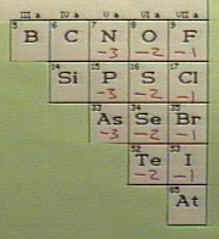
|
We can talk about carbon gaining four electrons to become a carbide ion but it does not have a strong enough attraction for electrons to actually do that.
Hydrogen will sometimes gain one electron to become a hydride ion with a negative one charge.
Practice with Names of Anions
Take time now to get some practice with anions by working on the following exercise (also shown in your workbook in exercise 7). Check your answers below or with the instructor.
| Nonmetal |
Anion Formula |
Anion Name |
| N | ||
| O | ||
| S | ||
| Cl | ||
| Br |
Answers
| Nonmetal |
Anion Formula |
Anion Name |
| N | N3- | nitride ion |
| O | O2- | oxide ion |
| S | S2- | sulfide ion |
| Cl | Cl- | chloride ion |
| Br | Br- | bromide ion |
Polyatomic Ions
It is also possible for several nonmetal atoms to cluster together in groups and form ions. They are called polyatomic ions. The formulas and charges of these polyatomic ions are not nearly so predictable as the simple anions you just studied. Nor are they all anions. The eight that you will need to memorize are listed here (and in example 8 in your workbook).
You need to know the names and formulas (including charges) for these eight polyatomic ions. Unfortunately, there is no "easy" way to predict their formulas/charges from the periodic table; you simply have to memorize them. Making flashcards and quizzing yourself throughout the week is one technique to learn them before the quiz.
| Important Polyatomic Ions | |
| Name | Formula |
| acetate | C2H3O2- |
| carbonate | CO32- |
| nitrate | NO3- |
| phosphate | PO43- |
| sulfate | SO42- |
| chlorate | ClO3- |
| hydroxide | OH- |
| ammonium | NH4+ |
Note that nearly all have "-ate" endings. Also, nearly all contain oxygen with one other element, and nearly all have negative charges. This is not a complete list of all the polyatomic ions that are known to exist, nor is it all of the common polyatomic ions. However, it is a good sample of the most common polyatomic ions and plenty for you to know for this class.
Soon (by the end of this lesson) you should memorize these, but in the meantime use this list when you need to work with the names and formulas of these polyatomic ions.