
Lesson 7: Bonding in Ionic Compounds
The sections on this page will focus on the compounds that are formed when oppositely charged ions attract one another. You will look at why they form networks and why they are compounds.
Networks
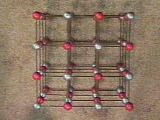
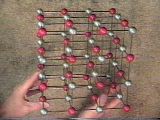
The nature of ionic bonding is such that the ions attract one another from all directions with each positive ion surrounded by negative ions and each negative ion surrounded by positive ions in such a way that a regular, repeating, three-dimensional pattern of alternating positive and negative ions is set up. This pattern is called a crystal lattice. |

|
This model shows the three-dimensional aspect. The red balls represent the negative ions and the silver balls represent the positive ions. Notice that each negative ion has positive ions above, below, to the left, to the right, in front and in back of it. All of the ions in the model are surrounded by oppositely charged ions. This model does not show the proper sizes of the positive and negative ions. The positive ions are actually much smaller than the negative ones because the positive ions have lost electrons and the negative ions have gained additional electrons. |
|
The nature of ionic bonding results in a network type of material. There's a network of alternating positive and negative ions that goes all the way through the entire crystal. Ionic bonding holds each ion to all of its neighbors and those in turn to all of their neighbors. The ionic bonding continues from ion to ion in three dimensions all the way through the entire crystalline material.
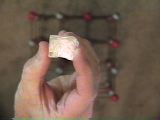
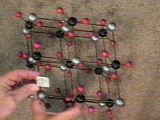
The shape of the actual ionic crystal is reflected in the pattern of ions in the model. While this (NaCl, left) is a very simple crystal pattern, others are more complex (CaCO3, right). But even in the more complex model, the pattern of the ions shows up in the crystal faces. An even better way of seeing this is to look at some of the models of ionic crystals that we have in the lab. Go over and take a look at those now if you are in the lab. If not, be sure to study them when you come to the lab. |
|
Compounds
A compound is defined as two or more elements combined (or bonded) in a fixed ratio. How does that apply to ionic bonding?
Within the crystalline network of ions, the ratio of cations to anions remains constant. That ratio depends solely on the charges of the cations and anions. The ratio of the number of cations to anions will be just opposite the ratio of charges on the ions, so that the amount of positive and negative charge is equalized. Because the ratio of ions is fixed, ionic bonding results in the formation of compounds, which have fixed composition.
In the next page, we'll spend time learning how to determine the formulas for ionic compounds and then name those compounds.