
Lesson 8: Chemical Bonding and Nomenclature II - Covalent and Metallic Bonding
In the last lesson we started learning about atomic bonding, we focused particularly on ionic bonding. In this lesson we will continue our study of the types of strong chemical bonds - focusing this time on covalent and metallic - which can be used to describe the bonding in pure substances (compounds and elements) and alloys. Those three types of bonds are represented in the models shown here; ionic bonding is represented by the model at the bottom with alternating "cations" and "anions". By the end of this lesson, you will be able to identify and describe the type of bonding represented in the other two models.
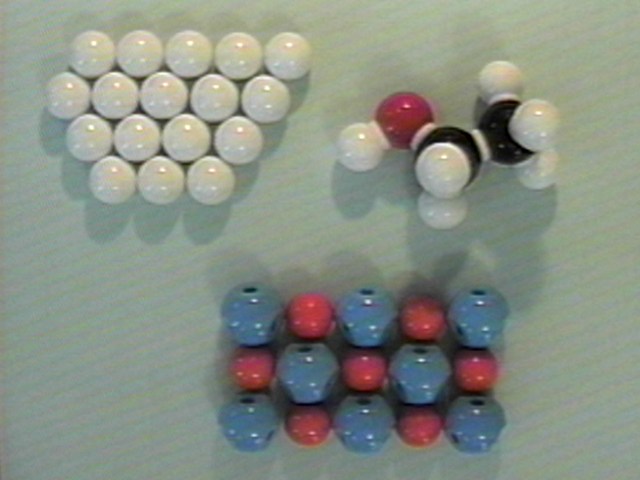
Your goal should be to understand the logic of chemical bonding. What causes the formation of bonds? What causes the formation of different kinds of bonds? What causes one atom to form one bond, another to form two bonds, and yet another to form a dozen bonds? To do this, we'll think about the kinds of elements that are bonding together and what happens to their electrons. |
|
You will need to be able to determine what type of bonding will hold certain atoms together. That decision will be based on what types of atoms are involved. You will need to be able to determine whether the atoms bond together to form molecules or a network. That decision also will be based on what types of atoms are involved. You will need to determine whether the atoms bond together to form an element, an alloy or a compound. That decision will also be based on the types of atoms involved. I think you can see that it will be very important to know quite a bit about the nature of the atoms you will be working with. |
|
You will also need to focus on what happens to the electrons of those atoms. Will they be lost, gained, shared or moved from one place to another. Again, this will depend on the nature of the atoms that are involved and how they interact with one another. |
|
In the next lesson we will take up weak chemical bonding (van der Waals, hydrogen, dipole-dipole and ion-dipole) which occurs primarily between molecules and deals with properties that the strong bonds are not directly responsible for.