
Lesson 8: Metallic Bonding
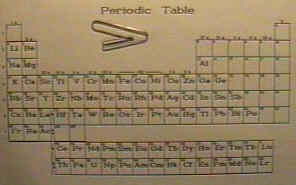
The metals are the most numerous of the elements. About 80 of the 100 or so elements are metals. You know from your own experience something about how metallic atoms bond together. You know that metals have substance and are not easily torn apart. They are ductile and malleable. That means they can be drawn into shapes, like the wire for this paper clip, and their shape can be changed. They conduct heat and electricity. They can be mixed to form alloys. How is it that metallic bonding allows metals to do all these things? |
|
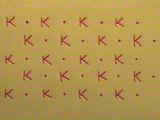
The nature of metals and metallic atoms is that they have loosely held electrons that can be taken away fairly easily. Let's use this idea to create a model of metallic bonding to help us explain these properties. I will use potassium as an example. Its valence electron can be represented by a dot. When packed in a cluster it would look like this (also in example 22 in your workbook). The valence electron is only loosely held and can move to the next atom fairly easily. Each atom has a valence electron nearby but who knows which one belongs to which atom. It doesn't matter as long as there is one nearby. |
|
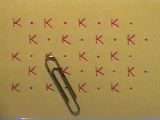
To emphasize that the valence electron is very loosely held, we can separate it from the rest of the atom and write it as "K+ and e-" rather than "K·". Packed in a cluster they look like this. These electrons are more or less free to move from one atom to another. Chemists often describe metals as consisting of metal ions floating in a sea of electrons. |
|

Network
The mutual attraction between all these positive and negative charges bonds them all together. Atom to electron to atom to electron and so forth. We have an array of atoms bonded to one another, that is, a network. The network in this paper clip (which of course is not made out of potassium), has a vast number of atoms that are all bonded to one another. This paper clip has on the order of 1022 atoms. The network of metallic bonding holds that entire chunk of metal together. Each metallic bond gives strength and the network extends that strength over the entire chunk of metal. |
|
How can this particular model of metallic bonding be used to explain the properties of metals (such as electrical conductivity, malleability, and thermal conductivity)? The key is in the loosely held electrons spread around and between all the metal atoms, or metal ions.
These electrons can move easily from one place to another, allowing for good electrical conductivity.
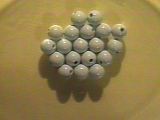
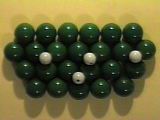
To a limited extent, the atoms can also move from one place to another and still remain in contact with and bonded to the other atoms and electrons around them. I will use these beads to represent the atoms. If these are shifted in position, the atoms still remain pretty much in contact with one another. Although the external shape of the metal is changing, the internal pattern is pretty much the same. Thus the shape of metals can be changed.
|
|


The atomic vibration that we measure as heat can be easily passed from one atom to the next making metals good conductors of heat as well as electricity.
Metallic Crystal Structure
Now let's take a quick look at the structural patterns that exist within metals. This pattern is called hexagonal-close-packing. You can see how six atoms surround this one. But we're only looking at two dimensions. There are actually twelve atoms next to this one - these six, three in a layer above, and three in a layer below. This pattern extends in three dimensions. When you are in the lab, look carefully at the models we have there and you can see layers of atoms extending in many directions. |
|

Elements and Alloys
If all of the atoms in a piece of metal are the same, we have a pure element. But what about metals like brass and steel that are not pure elements? What happens if we add different elements, different kinds of atoms, heat them until they melt and mix them? When we do that, we get a mixture of atoms that we call an alloy. The ratio of atoms of one kind to another is not fixed. The composition of the mixture will vary depending on how many of each kind of atom (or how much of each kind of element) happens to be available.
If the atoms are about the same size, we get a substitution alloy. One kind of atom just takes the place of another kind of atom. The network pattern remains more or less the same. |
|

| If the added atoms are much smaller than the atoms in the network, like the carbon atoms added to iron to make steel, they can fit into the holes between the layers of atoms in the network. When this happens we call it an interstitial alloy. |
|
The presence of different kinds of atoms alters the bonding and changes the properties of the metal. For example, steel is stronger than iron; bronze and brass are both stronger than copper.
Naming Alloys?
There is not yet a systematic way of naming alloys like those you have learned for naming covalent and ionic compounds. In part, this is because alloys are not compounds, their composition is variable and their names need to reflect that. Generally, we use common names like brass, bronze, or steel or technical names like alnico I, alnico II, chromium steel or high carbon steel. You will not be held responsible for naming alloys in this course.
Metallic Review
All metals share the characteristics of conducting heat and electricity and being ductile and malleable. However, they do not all exhibit those characteristics equally well. Some metals are better conductors than others. Some are harder. Some are softer, and so on. With a little bit of thought about the position of different metals on the periodic table, how tightly they hold onto their electrons, and also the nature of metallic bonding you should be able to make some predictions about how the properties of different metals would compare to one another.