
Lesson 3: Chemical Equations
Now that you are familiar with the differences between electrolytes and nonelectrolytes, and also between strong and weak electrolytes, let's consider how to symbolize the process by which these solutions are formed. After that we will describe what kinds of atomic or molecular changes are taking place. Then we will take a look at how to use your understanding of the process to identify acids, bases and salts from their formulas and the ions that are formed when they go into solution.
You have already learned to write equations for chemical reactions and we'll be doing the same type of thing here. However, we'll be using the following additional symbols:
- We use (s) to mean solid,
- (l) for liquid,
- (g) for gas,
- and (aq) for aqueous, which means that the material is dissolved in water.
These symbols are written after the formula for each chemical to show what state or phase the material is in. For example when water melts it changes from solid to liquid. To show this in an equation we would write:
H2O(s)
H2O(l).
With that background, move on to each of the topics in this section.
Dissolution Reactions | Molecular Changes | Identifying Acids, Bases, and Salts | Ionic Equations
Dissolution Reactions
First let's deal with symbolizing this process by writing chemical equations for dissolution reactions.
The equations for dissolution reactions that are discussed on this page are also shown in Example 12 of your workbook.
Nonelectrolytes
When a nonelectrolyte dissolves into solution the change is a relatively simple one. The chemical changes from its original state (the solid or liquid or gas phase) and goes into solution becoming aqueous. No other changes take place. The molecules are separated from one another, surrounded by water molecules, and that's all that happens.
Alcohol is a liquid. When it dissolves in water, the alcohol molecules separate and become surrounded by water molecules. |
C2H5OH(l) |
Oxygen molecules exist in the gaseous state. When oxygen dissolves in water, the oxygen molecules become surrounded by water molecules. Oxygen is only slightly soluble in water and comes out of solution very easily. To show that the reverse process also happens, we can write a reverse arrow. Arrows going in both directions show that the reaction goes in both directions. |
O2(g) |
Strong Electrolytes
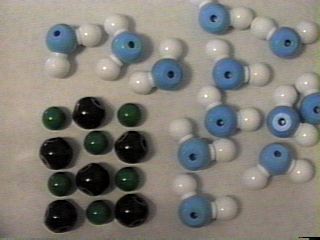
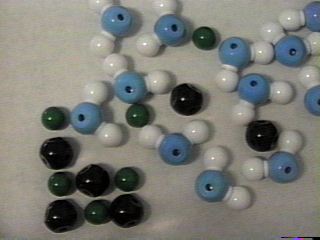
In the case of a strong electrolyte, something else happens. We know that for a solution to conduct electricity, there must be ions in that solution. So if a material (solid, liquid, or gas) goes into solution and allows the solution to conduct electricity, then it must have been ionized or split into ions in the process. So the general format for an equation for the dissolution of a strong electrolyte is that the material, AB (solid, liquid, or gas) will change to the aqueous A+ ion, plus the aqueous B- ion.
|
AB(s,l,g) |
In other words, the material not only goes into solution and is surrounded by water molecules, it also is ionized, that is, it splits up into ions. Any time an ionic compound dissolves in water, this is the process that takes place. There are also some molecular materials that will ionize in water. The second equation is shown to make sure that you realize that sometimes an ionic compound will split into more than two ions. It might split into three or four or more.
Hydrogen chloride is a gaseous molecular material that can be viewed as splitting up into ions when it dissolves in water. A better view is that it chemically reacts with water and we will explore that approach later in the lesson on acids and bases. |
HCl(g) |
When the ionic compound sodium chloride dissolves in water, the sodium ions and chloride ions from the salt crystal separate from each other and become surrounded by water molecules. |
NaCl(s) |
In this next case, we have the compound Na2SO4 which splits into two Na+ ions for every one SO42- ion when it dissolves. You should remember that sulfate ion is a polyatomic ion and does not break up into separate sulfur and oxygen ions or atoms. If you don't remember that, you should take some time before you finish this lesson to review the names and formulas of the polyatomic ions that you learned during the previous course. |
Na2SO4(s) |
Weak Electrolytes
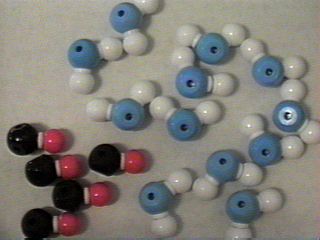
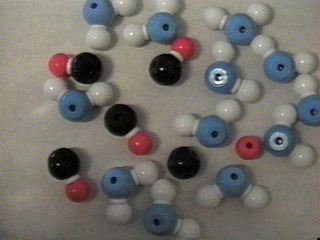
When a weak electrolyte dissolves in water, a more complicated situation occurs. Here the molecule AB (solid, liquid, or gas) goes into solution and that same molecule is surrounded by water molecules. But something else takes place. Some, not all, but some of those molecules dissociate (split up) into ions.
|
AB(s,l,g) |
The double arrow indicates that this is an equilibrium reaction, similar in some ways to the saturated solution that we worked with before. The AB molecules split up to form A+ ions and B- ions. Those ions in turn reassociate to form the AB molecules. An equilibrium is set up where the molecules are dissociating just as fast as the ions are recombining to form molecules. At any given time only a portion of the molecules will be dissociated. There will not be as many ions as possible, therefore this solution will not conduct electricity as well as a strong electrolyte which does dissociate completely into ions.
This equation shows what happens to acetic acid, a liquid, when it dissolves in water. The acetic acid molecules separate from one another and are surrounded by water molecules. Some of these acetic acid molecules will react with water and dissociate into ions. The dissociated ions can also recombine to form molecules. |
|
C2H3O2H(l) |
Next, let's consider the molecular changes that take place when a chemical dissolves in water.
Molecular (& Ionic) Changes
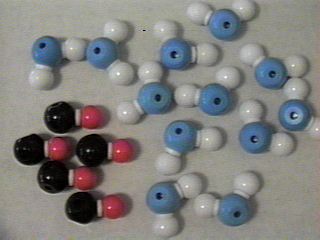
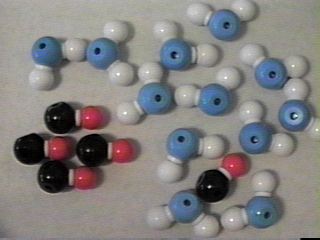
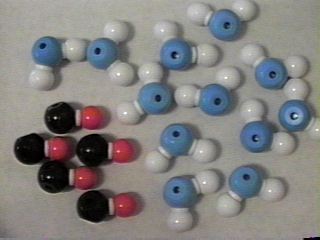
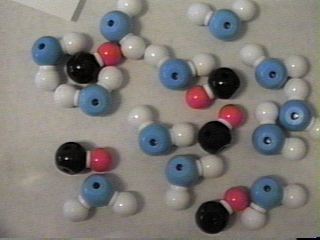
Now let's consider what's actually happening at the atomic or molecular level when chemicals dissolve. I will try to illustrate the process using models. There are also some diagrams in example 13 in your workbook to help illustrate what changes are taking place. You have to keep in mind that during the process of dissolving, the process of forming a solution, some bonds are broken, and other bonds are being formed.
|
|
|
The bonds that are being broken are the bonds that are holding the solute together; the bonds that are being formed are the bonds that exist between the solute and the solvent. In general what's happening is that the solute particles, whether they are ions or molecules, are being surrounded by solvent molecules and being pulled away from the others. In order for this to happen, some of the solvent to solvent bonds have to be broken also. In other words, in order for a group of water molecules to surround an ion, that ion has to get in between the water molecules. Which means that not only do you have to break the bonds that exist between that ion and another ion, but you also have to break the bonds that exist between the water molecules that the ions move between.
Nonelectrolytes
|
||
|
|
|
Weak Electrolytes
|
||
|
|
|
Strong Electrolytes
|
||
|
|
|
With these models and the equations in examples 12 and 13 you have seen how we represent the different forms in which chemicals can exist as they dissolve and possibly dissociate. We have a special name for each part or form in which a chemical exists when it is dissolved in solution. We call these chemical species.
Let's refer back to some of the chemicals shown in example 12. When NaCl dissolves in water we don't really have any NaCl as such in the solution. We have Na+ and Cl- ions because NaCl dissociates. We say "the species present in solution are Na+(aq) and Cl-(aq)." The same is true for any strong electrolyte -- the species present in solution are the ions.
For a nonelectrolyte, like C2H5OH, which does not dissociate into ions the specie present is the same as before it was put into solution except that it is surrounded by water molecules. Nonelectrolytes have molecular species in solution unlike strong electrolytes which have ionic species in solution.
Weak electrolytes have both molecular and ionic species present in solution because some of the molecules dissociate into ions and some do not. Usually the molecular species are present in much greater numbers than the ionic species because only a small percentage of the molecules in a weak electrolyte actually dissociate.
Now you should practice determining what species are actually present in solutions of the chemicals listed in exercise 14. In some cases you should be able to determine whether or not the chemical dissociates (hint: use the solubility rules - if it is soluble then it does dissociate). For those, just the formula of the chemical is given. In other cases you are not expected to know whether or not the chemical dissociates. For those, you are also given whether the chemical is a strong electrolyte or a weak electrolyte or a nonelectrolyte. So take time to do that now and I'll help you check your answers when we continue with the lesson.
What chemical species actually exist in each of the following solutions?
HCl(aq) |
strong electrolyte |
NaCl(aq) |
|
BaCl2(aq) |
|
HNO3(aq) |
strong electrolyte |
HF(aq) |
weak electrolyte |
K2SO4(aq) |
strong electrolyte |
Mg(NO3)2(aq) |
|
KOH(aq) |
|
CH3OH(aq) |
nonelectrolyte |
Answers
HCl(aq) |
strong electrolyte |
H+(aq), Cl-(aq) |
NaCl(aq) |
ionic, strong electrolyte |
Na+(aq), Cl-(aq) |
BaCl2(aq) |
ionic, strong electrolyte |
Ba2+(aq), Cl-(aq) |
HNO3(aq) |
strong electrolyte |
H+(aq), NO3-(aq) |
HF(aq) |
weak electrolyte |
HF(aq),H+(aq), F-(aq) |
K2SO4(aq) |
strong electrolyte |
K+(aq), SO42-(aq) |
Mg(NO3)2(aq) |
ionic, strong electrolyte |
Mg2+(aq), NO3-(aq) |
KOH(aq) |
ionic, strong electrolyte |
K+(aq), OH-(aq) |
CH3OH(aq) |
nonelectrolyte |
CH3OH(aq) |
Identifying Acids, Bases, and Salts
Once you have learned the concept of electrolytes dissociating in water to form ions and can write chemical equations for that process, the task of identifying acids, bases and salts is relatively easy. (When a chemisty refers to a "salt" is any ionic compound - it does not necessarily mean sodium chloride.)
Starting with the formula of an electrolyte, first identify the postive and negative ions that will be formed when the electrolyte dissolves in water. If the positive ion is H+ the compound is an acid. If the negative ion is OH- the compound is a base. If neither of the above is the case the compound is a salt. Note that this all depends on the compound being an electrolyte (either weak or strong). |
|
Ionic Equations
Next, I would like you to get some practice writing equations to represent ionic compounds going into and out of solution.
Example
Let me point out what I mean by this using sodium chloride as an example. |
|
When solid sodium chloride dissolves in water, that process can be represented by this equation. |
NaCl(s) |
Conversely, when solid sodium chloride crystallizes out of solution, that process can be represented by this equation. |
Na+(aq) + Cl-(aq) |
Practice
Now try your hand at writing equations for dissolution and precipitation reactions which you observed earlier in the lesson by doing exercise 15 parts a and c (shown here and in your workbook). Then continue with the lesson after checking your answers below. We'll get to part b in the next page of the lesson, Precipitation Reactions.
- For each of the soluble compounds in exercise 8, write a balanced equation showing the species formed as the compound goes into solution and indicating whether each one is solid, liquid, gas or aqueous.
- For the experiment in exercise 10, write a balanced equation for the dissolution of sodium acetate and for its crystallization.
Answers
Exercise 8 - Dissolution Reactions
NaOH(s)
MgSO4(s)
Ba(NO3)2(s)
Exercise 10 - Dissolution and Crystallization Reactions
NaC2H3O2(s)
Na+(aq) + C2H3O2-(aq)
or together as NaC2H3O2(s)
Na+(aq) + C2H3O2-(aq)