
Lesson 3: Electrolytes
There is still another way of classifying solutions, and it has to do with their electrical properties. If you take a material which does dissolve in water, the resulting solution will conduct electricity to varying degrees, anywhere from hardly at all to very well, depending upon what the material is.
Materials which do not increase the electrical conductivity of water when they are dissolved in the water are referred to as nonelectrolytes. Materials which do increase the electrical conductivity of water when they dissolve are called electrolytes.
Even among electrolytes, there are some variations. We can talk about weak electrolytes, and we can talk about strong electrolytes. Strong electrolytes increase the electrical conductivity of the water much more than do the weak electrolytes for comparable concentrations. All of this is summarized below.
Materials soluble in water:
- Nonelectrolytes do not increase the electrical conductivity of water
- Electrolytes do increase the electrical conductivity of water
- Weak electrolytes cause a mild increase in conductivity
- Strong electrolytes cause a greater increase
A diagram in your workbook (Exercise 11) has space left for some examples. You should fill in those spaces by checking out the conductivity section below and by testing the electrical conductivity of several solutions when you come into the lab.
Conductivity
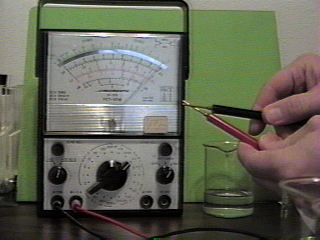
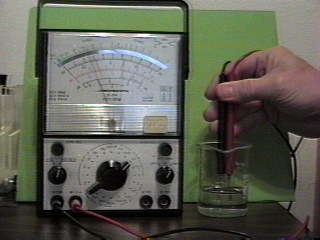
The conductivity of solutions can be tested by using an ohmmeter such as the one shown here. When there is little or no electrical conductivity between the probes the needle on the meter points to the left of the scale ("infinite" ohms). |

|
When there is very good electrical conductivity between the probes (as when they are touching) the needle on the meter points to the right of the scale (0 ohms). |
|
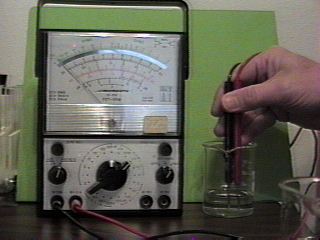
When the probes are placed in water, as shown here, you can see that the meter needle is still far to the left. Pure water does not conduct electricity very well. |
|
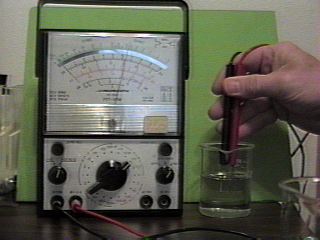
When the probes are placed in a solution containing sodium chloride, the meter needle moves quite a ways to the right showing that the solution conducts electricity very well. Thus, sodium chloride is a strong electrolyte. |
|
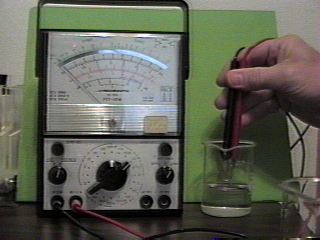
When the probes are placed in a solution containing sugar, the meter needle does not appear to move away from the left end of the scale showing that the solution does not conduct electricity any better than pure water. Thus, sugar is a nonelectrolyte. |
|
When the probes are placed in a solution containing vinegar (acetic acid), the meter needle moves somewhat to the right showing that the solution conducts electricity somewhat. Thus, acetic acid is a weak electrolyte. |
|
The tests of conductivity shown above are somewhat crude because a number of factors come into play when determining the resistance of a solution to conducting electricity. These factors include concentration of the solute, distance between the probes, and also how far into the solution the probes are placed. For comparisons I tried to keep these factors the same for each test.