
Lesson 9: Electric Current
We need to look at several aspects of the nature of electric current because it varies depending on the material in which it is flowing. In this lesson we will consider electric current in metals, in solutions, and at electrodes. As you will see, something different happens with electric current in each of these materials.
In Metals
Let's review our old model of metallic bonding. Metals consist of closely packed atoms which have loosely held electrons which are relatively free to move from one atom to another. |
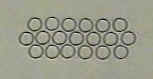
|
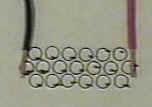
If we connect something negatively charged (a negative voltage - black wire) to one end and something positively charged (a positive voltage - red wire) to the other end, the loosely held electrons in the wire will flow from one end toward the other. This flow of electrons is related to the electric current in a wire. |
|
Unfortunately, when electric current was first created and studied, it was presumed that something positive was moving from the positive end toward the negative end.
When you hear someone talking about electric current flowing from positive to negative, they are using this original concept of electric current.
Much later, electrons were discovered. They were found to have a negative charge and it was determined that they were what was moving in metal wires when electric current flowed.
To avoid confusion with terminology and to keep the concepts separate, I will usually refer to electron flow, rather than current.
In Solutions
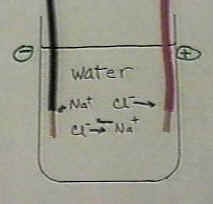
In solutions things are different. Free electrons are not available to carry the current. Instead, charged ions are present in the solution and are free to move around. |
|
|
If we "connect" something negatively charged (a negative voltage - black wire) to one side and something positively charged (a positive voltage - red wire) to the other side, the positively charged cations move one way (toward the negative) and the negatively charged anions move the other way (toward the positive). |
|
 Na+ Cl-
At Electrodes
Chemistry comes into play at the electrodes. Electrons are transferred into or out of the solution at the electrodes.
The electrode where electrons are transferred into the solution is called the cathode. The chemical process (or reaction) that occurs at the cathode is called reduction because the negatively charged electrons will reduce the oxidation state or charge of the chemical they attach to. |
Cathode Reduction |
|
|
An example of the kind of thing that can happen is that a sodium ion takes on an electron from the cathode and becomes a sodium atom. Again, this is called reduction because the charge is reduced from +1 to 0. |
|
||
|
|||
The electrode where electrons are transferred out of the solution is called the anode. The chemical process (or reaction) that occurs at the anode is called oxidation because removing negatively charged electrons from a chemical will increase the oxidation state or charge of that chemical. |
|
Anode
Oxidation |
||
An example of this might be removing an electron from a chloride ion. The removed electron goes from the chloride ion to the anode. The chloride ion becomes a chlorine atom. Again, this is called oxidation because the charge or oxidation state is increased from -1 to 0. |
|
|||
|
||||