
Lesson 9: Electrolysis, cont.
We'll continue our exploration of electrolysis with electrolysis of a molten salt, the process of electroplating, and, finally, a look at the calculations associated with electrolysis.
Electrolysis of a Molten Salt | Electroplating | Faraday Calculations
Electrolysis of a Molten Salt
Now let's consider the electrolysis of salts that are not in solution.
Sodium Chloride
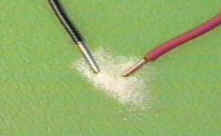
The example we will use is the most common of the salts, sodium chloride. An important thing to note is that solid sodium chloride does not conduct electricity. |
|
However, molten sodium chloride does. In this case we are dealing with molten sodium chloride. That simply means that we've taken sodium chloride and heated it up enough to where it is melted. When it melts, the sodium ions and the chloride ions can separate from one another somewhat, and they are free to move throughout the liquid.
This diagram (example 5 in your workbook) shows that the voltage source is forcing electrons through the wire from right to left. Electrons are forced onto the electrode on the left. The electrons are picked up by the sodium ions. The sodium ions react with electrons at the electrode over on the left to form sodium metal. Since this is reduction, that electrode is called the cathode. |

|
Anode: |
Cathode: |
||
Over on the right side, electrons are being pulled off of the chloride ions to form chlorine gas, which would bubble away unless it was somehow captured. Since this is an oxidation process, the electrode on the right side of this particular diagram would be called the anode because that is where the oxidation occurs. The net result of this reaction is the production of sodium and chlorine from sodium chloride by forcing a current through the cell. That current is forced by the external power supply or voltage source. |
||
 Cl2 + e-
Sodium chloride is not the only salt that can be used in this process. We could use any ionic compound that can be melted to free up the ions so that they can move.
Aluminum Oxide
An example is that aluminum metal can be generated from aluminum ores by this process. I would like you to consider the case of passing an electric current through molten aluminum oxide.
The diagram in exercise 4 in your workbook is a blank version of the diagram shown above for sodium chloride. Use it to describe what happens when an electric current is passed through molten aluminum oxide. Presume that the electrodes are inert and won't get involved in the reactions. Refer back to the sodium chloride example (ex. 5 in your workbook) as needed. When you have finished, check your answers below to make sure that you have included all the necessary components in your diagram. |

|
Some practical considerations to consider when actually making aluminum metal by this process include these. Are the electrodes really inert? How hot does aluminum oxide have to be to stay molten? Can people work around those temperatures? What voltage and current are needed to make this happen? And, of course, there are the economic and environmental issues of the cost and availability of large amounts of electricity and the price at which aluminum can be sold. If you know or meet someone who has worked in an aluminum plant, you might ask them how some of these practical considerations have been addressed.
Answer
Voltage source: These answers presume the electrons to flow to the left. If you set the electron flow to the right the position of electrodes and reactions will be opposite. |

|
|
In the molten salt area of the diagram you should have Al3+ and O2- because these are the ions that are found in Al2O3. |
||
cathode |
anode |
|
reduction |
oxidation |
|
Al3+ + 3 e- |
2 O2- |
|
Electroplating
Electroplating is another example of the use of an electrolytic cell.
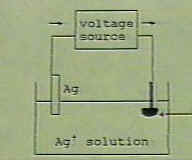
In this particular case (example 6 from your workbook), an electrolytic cell is being used to silverplate a spoon (or at least the bottom half of the spoon since that is all that is in the solution). The power supply in this case is forcing electrons from the left to the right. The electrons go into the
electrolytic cell onto the spoon. The presence of electrons on the spoon will cause the
silver ions to plate onto the spoon as silver metal. We call this
electrode the cathode because this is where reduction is taking place.
The half-reaction is Ag+ + e- At the other electrode, the anode, oxidation is taking place and something is giving up electrons. For good electroplating it should be silver, because if it is not silver then different ions would mix into the solution as that particular metal is oxidized. When that happens, those metal ions will plate onto the spoon as well as the silver. Notice the overall reaction is that silver becomes silver. The only real change is where the silver is. It has been moved from the silver bar on the left to the spoon on the right. |
|
|
Anode |
Cathode |
|
Overall reaction |
||
Practice
Now use the diagram in exercise 3 in your workbook to show how you could go about copper plating a fork. Refer back to example above (example 6 in your workbook) if you need to. When you are done, check your answers below or discuss your diagram with an instructor to make sure you have included all the necessary components. |

|
Electroplating is a very important industrial process. Again, if you happen to know or meet someone who works in any of the local tool or metal processing companies, you might ask them if they can tell you about some of the coatings that go onto various tools and the steps that have to be followed to make the process work.
Answers
If the power supply forces electrons to the left, the cathode will be on the left as shown here. If you chose to force the electrons to the right, the position of the electrodes and reactions will be opposite what is shown here. |

|
|
The solution should contain copper ions and some type of anion. The fork to be plated should be the cathode. The anode should be made of copper. |
||
cathode |
anode |
|
Faraday Calculations
In electrochemical reactions, electrons are transferred from one chemical to another. How many grams or moles of the chemicals will react depends on how many electrons or moles of electrons are transferred. This in turn depends on how much electric current is used and how long it runs.
There is a special name for one mole of electrons. One mole of electrons is called a Faraday. (Named in honor of Michael Faraday, a British scientist in the early 19th century.) Actually, a Faraday is the amount of electric charge on one mole of electrons, rather than being the electrons themselves.
The amount of a chemical that reacts can be related to the current in amps (which can be expressed as coulombs per second) and the time that the current flows (measured in seconds) by this equation. Some conversion factors are necessary to change from the physical measurements of time and current to the chemical measurements of moles. The last factor shown here deals with the fact that different chemicals require a different number of electrons to change from one oxidation state to another. For example, sodium requires one electron to change from Na+ to Na, but aluminum requires three electrons to change from Al3+ to Al.
moles of chemical = current x time x conversion factors |
|||||||||
|
In this course, what you need to know about Faraday calculations is this descriptive relationship between Faradays, electrons, current, time and extent of reaction. You won't be called upon to carry out these calculations.