
Lesson 9: Electrolysis
In the next two sections of the lesson we will look at the process of electrolysis. Electrolysis involves the forced transfer of electrons from one chemical to another.
In turn we will consider the electrolysis of water, electrolytic solutions and molten salts. After that comes a look at the process of electroplating followed by a brief mention of the calculations that relate time, current and the amount of a chemical that reacts in an electrolytic cell.
Electrolytic Cells
The examples we will consider in this section are examples of what we call electrolytic cells. An electrolytic cell is a combination of electrodes and chemicals through which an electric current is forced. In these cells, electricity is used to force chemical reactions.
Electrolytic cells come in many forms and are used for a variety of purposes, such as electroplating with chrome and silver, extracting aluminum from aluminum ores, and even generating metallic sodium and gaseous chlorine from salt. Let's take a closer look at that last one.
Electrolysis of Water
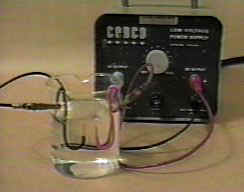
Let's begin the study of electrolysis by looking at the electrolysis of water. Water does conduct electricity, but only poorly. |
|
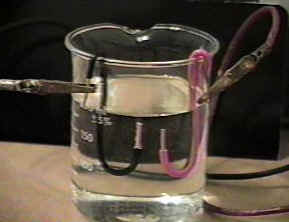
By observation and testing we have determined that the products are H2 and O2. |
|
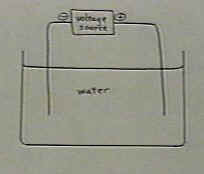
In your workbook you have a diagram something like this in exercise 1. Take notes on that while we use it to look at what happens at each electrode. |
|
Cathode
Electrons from the negative end of the power supply are forced into water at the cathode. This process is called reduction because the negatively charged electrons reduce the charge (oxidation state) of the hydrogen. In the reaction, hydrogen is freed from the water and released as a gas. The unbalanced equation for this reaction can be written this way.
|
|
|||||||||||||
Let me elaborate on what is happening in this reaction using electron dot diagrams. An electron with a negative charge is forced into the water molecule letting an H atom leave with its own electron. Or perhaps the presence of the electron allows the H atom to move away from the water molecule and leave its own electron behind (with O). |
|
|||||||||||||
As you know, a hydrogen atom with a single electron doesn't just sit around doing nothing. It likes to pair up with another hydrogen atom to form a hydrogen molecule. The process shown here occurs twice and the two hydrogen atoms combine to form a hydrogen molecule. |
|
|||||||||||||
Overall, this is the reduction reaction that takes place at the cathode. |
|
 H2 + OH-
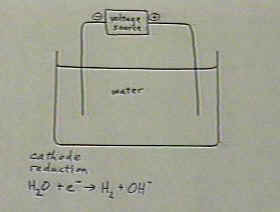
You may have noticed that this reaction alters the H+/OH- balance around the cathode making the solution more basic.
Anode
The anode is connected to the positive end of the power supply. Electrons are forced out of the water molecules. This process is called oxidation because the loss of electrons increases the oxidation state of an element (in this case the element is oxygen). In the reaction, oxygen is freed from the water and released as a gas. The unbalanced equation for this reaction can be written this way.
|
|
||||||
Again, let me elaborate on what is happening in this reaction using electron dot diagrams. In the first step, an electron is removed from the water molecule. Removing the electron from the bond between H and O releases the H (without its electron) from its bond with O. In the second step, a second electron is removed, which also frees a second hydrogen ion. The oxygen has now lost two electrons and is an oxygen atom with two unpaired electrons. |
|
||||||
If this reaction occurs twice, two oxygen atoms are formed, which combine to make an oxygen molecule. |
|
||||||
Overall, this is the oxidation reaction that takes place at the anode. |
|
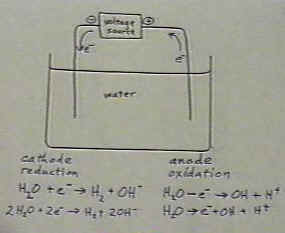
Again, you may have noticed that this reaction alters the H+/OH- balance around the anode making the solution more acidic.
Electrolysis of Electrolytic Solutions
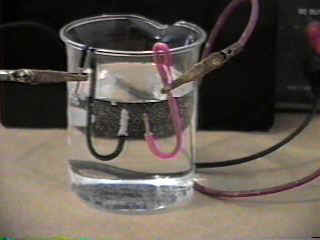
When an electrolyte is dissolved in water it will cause an increase in the electrical conductivity. In this beaker an electrolyte has been added to the water. Perhaps you can see that the gas bubbles are more abundant here than they were in the picture of the electrolysis of water. |
|
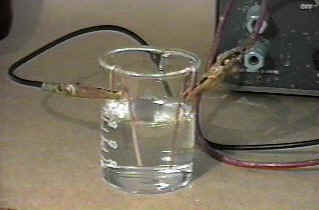
What happens during the electrolysis of a solution depends on what is in the solution and even materials that electrodes are made of, as you will see. In this case silver nitrate has been added to the water. The electrodes are made of copper. |
|
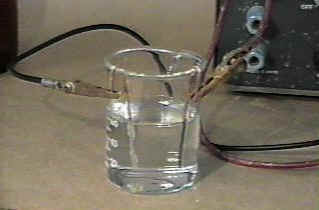
After a short period of time, you can see that silver crystals have formed on the cathode (left side, black wire) and have begun to fall off. On the right side, around and below the anode (connected to the red wire), I hope you can see a light blue color. Let's investigate the reactions that caused these changes. |
|
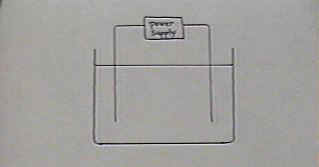
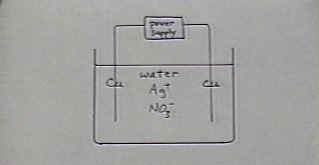
In example 2 in your workbook you will find a diagram similar to this. I recommend that you use it for notes. As we work through this example, I will allude to various possible reactions that might occur and expand upon those that do occur. The reason for this is to emphasize that generally more than one reaction might occur even though one might be favored over the others. For now, realize that there are a variety of reactions that might occur. Later in this lesson we will talk about how you can decide which of the possibilities is most reasonable. |
|
In this particular case both of the electrodes were made of copper. The solution was, of course, primarily water. It also contained Ag+ and NO3-. |
|
|
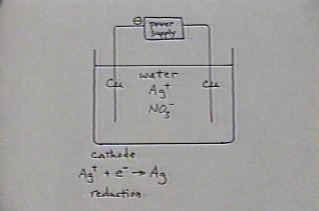
Cathode Reaction The cathode reaction in this case is the simplest so let's deal with it first. At the cathode, electrons from the negative pole of the power supply are coming to the solution. These negative electrons attract silver ions (Ag+) and combine with them to make silver metal. The process is reduction because the charge
(oxidation state) of the silver decreases (Ag+1 The equation for the reaction is Ag+ + e- |
|
|
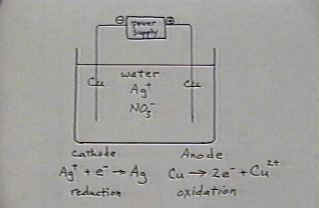
Anode Reaction At the anode we have several possibilities to consider. At the anode, electrons are being taken away and moved to the positive pole on the power supply. But what are they being taken away from? They could be taken away from the negatively charged NO3- ions, but they're not. They could be taken away from water to make O2, but they're not. Instead they are taken away from the copper atoms that make up the anode. |
|
Copper atoms react by giving up electrons and becoming copper(II) ions. The equation for the reaction is Cu One bit of evidence for this is the blue color that appeared in the solution near the anode. Cu2+ ion is blue in water. More evidence to verify this would be to weigh the electrode before and after the reaction. If the reaction runs long enough, there would be a detectable weight loss in the anode itself. |
|
Recap
There are several points to be made from this example.
Ions may react instead of water. |
|||||||||||||||||||||
This is an example of electroplating which we will look at later. |
|||||||||||||||||||||
What happens at each electrode?
|
Questions to Ponder
Let's refer back to the electrolysis of water and consider a few questions.
Why didn't the anode oxidize? This question brings up the idea of a different ease of oxidation for different chemicals. Later in this lesson we will work with a list of oxidation abilities.
Why didn't something plate out on the cathode? This question brings up the issue of availability. Only what is there can react. If more than one chemical is available, do they all react? Just one? Which one(s)? Later in this lesson we will also work with a list of reduction abilities.
What about the voltage needed for electrolysis? Will any amount do? Is it different for solutions? Later in this lesson we will also work with a list of voltage potentials.
For now, move on to the electrolysis of a molten salt on the next main page of the lesson.