
Lesson 9: Spontaneous Electron Transfer
In this section we will deal with spontaneous redox reactions. These reactions do not have to be forced by passing an electric current through the chemicals.
Let's review some examples of spontaneous redox reactions.
Na + water: |

|
K + water: |

|
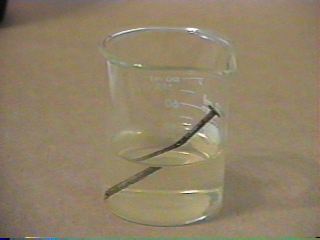
Fe + water: |
|
When you observed some of those reactions in the previous course (CH 104), we talked about them in terms of the sodium and potassium (and calcium and magnesium) losing electrons. Did you happen to ask or wonder where those electrons went? At that time it wasn't important. Now we will start considering that type of thing.
In the pages of this section we will consider the spontaneous reactions of
Metals with Water | Metals with Cations | Nonmetals with Anions
Metals with Water
Potassium with Water
Let's start with an equation for the reaction of potassium with water (which is also in your workbook in example 10a). This equation is not balanced. We could balance it now, but that won't be necessary for our purposes at the moment. The reaction between potassium and water results in the formation of potassium hydroxide and hydrogen gas. |
|
|
Because potassium hydroxide is soluble in water, we can write it in the ionic form. So this equation does a better job of showing what actually happens. The potassium reacts with the water to form potassium ion and hydroxide ion and also hydrogen gas. |
|
|
Let us consider what actually happened in this case. The potassium loses electrons. What we were studying last term was how readily potassium lost electrons compared to other metals. But now let's look at where the electron goes. The hydrogen in the water is what takes the electron. So, the metal loses electrons and the hydrogen gains electrons. |
||
 KOH + H2
This is the essential quality of oxidation-reduction reactions: one chemical element loses electrons and another gains them. Another way of saying this is that electrons are transferred from one element to another. Note that oxidation and reduction must happen both at the same time. When an electron leaves something, it goes to something else. In a redox reaction the electrons are transferred from one chemical to another.
Let's take a look at potassium's half of the reaction. What happened to the potassium? It changes from potassium metal K to potassium ion K+. |
|
|
In doing so, it gives off an electron. This is a better way of showing what happens to the potassium because it shows that charge is conserved. The electron doesn't just disappear. The equation shows that it's still around but has separated from the rest of the potassium atom. |
|
Next, what is happening to the hydrogen? Here is its half of the reaction. The water changes from H2O to OH- and gives off hydrogen gas H2. |
|
|
This form of the equation balances the atoms involved in the reaction. But notice that the charge is not the same on both sides even though the total number of atoms is. |
|
|
In order for this reaction to take place, two electrons have to combine with the water in order to form the two hydroxide ions and hydrogen gas. This is what's shown here. This is hydrogen's half of the reaction. |
|
The potassium reacts to give off electrons, so that is an oxidation reaction. |
|
|
The hydrogen in the water is gaining electrons so that is a reduction reaction. |
|
|
The number of electrons gained by the water must equal the number of electrons lost by the potassium. Consequently two potassium atoms must react to provide the two electrons needed by the water. |
|
|
When these two half-reactions are added together, the electrons cancel out and we get the complete balanced equation for this redox reaction. |
|
The same kinds of equations can be written for any reaction in which a metal reacts with water.
Practice
Try your hand at writing these kinds of equations by considering the reactions that the metals Na and Ca have with water. From their position on the periodic table, you can tell that Na and Ca form the ions Na+ and Ca2+. Check your answers below before you continue with the other pages.
Answers
Because sodium, like potassium, loses one electron per atom, the equations are nearly identical to the equations above. |
|
|||
Because calcium atoms lose two electrons, the equations are slightly different. By the way, because calcium hydroxide is an insoluble compound the calcium and hydroxide ions will combine together to form a precipitate. |
|
Metals with Cations
Another common type of redox reaction is the one between metal atoms and and the cations of other metals. You will see quite a few of these reactions when you do the lab work for this lesson.
Example
We will use the reaction between zinc metal and copper(II) ion as an example. Here you can see a piece of zinc metal in a copper(II) nitrate solution. |

|
||
| In time, a reaction occurs. |

|
||
The equation for the reaction can be written in this way. But let's dissect this equation to see what is really going on. |
|
||
The nitrate ions are spectator ions in this reaction. If we leave them out we can focus on the atoms and ions that are directly involved in the reaction. |
|
||
Taking this one step further we can separate the half-reactions of zinc and copper from one another. Note that zinc is being oxidized and losing two electrons. Copper is being reduced and gaining two electrons. Specifically, metallic zinc (Zn) is being oxidized and copper(II) ion (Cu2+) is being reduced. |
|
More Examples in the Lab
You will see many more examples of this type of reaction when you do your lab work for this lesson. When you do that it will be very important to make note of which form (ion or atom) of each element is reacting.
Nonmetals with Anions
We are not limited to metals when dealing with redox reactions. Let's look at the reaction of a nonmetal with an anion to show what can happen on the other side of the periodic table.
Bromine and Iodide
Here are the the chemicals for this example: aqueous sodium iodide solution containing I- in the bottle and molecular bromine (Br2) dissolved in some carbon tetrachloride in the tube. |
|
|||
At the beginning of the reaction (left) the red Br2 is dissolved in the nonpolar carbon tetrachloride layer at the bottom of the tube and I- is in the water layer on top. After the reaction (right) the purple color of I2 can be seen in the nonpolar carbon tetrachloride layer at the bottom of the tube. |
|

|
||
The unbalanced equation for this reaction can be written in this way. |
|
|||
Because the sodium ions are spectator ions they can be removed from the equation to show what is happening to the bromine and iodine. |
|
|||
We can dissect this equation and write separate balanced half-reactions for the bromine and the iodine. |
|
|||
These half reactions can be added together to give the balanced equation for this redox reaction. |
|
|||


Note that in these reactions with nonmetals the change from atom to ion is reduction, whereas with metals the change from atom to ion is oxidation. That is an important difference between metals and nonmetals.